Petanque Rules & Regulations

Master the traditional French sport of petanque with our comprehensive guide to official rules and tournament regulations.

Petanque glossary

2-6 Players

Teams of 1, 2, or 3 players

13 Points

First team to reach 13 points wins

60-90 Minutes

Average game duration

Simple Scoring

Points based on closest boules

Basic Rules

Equipment

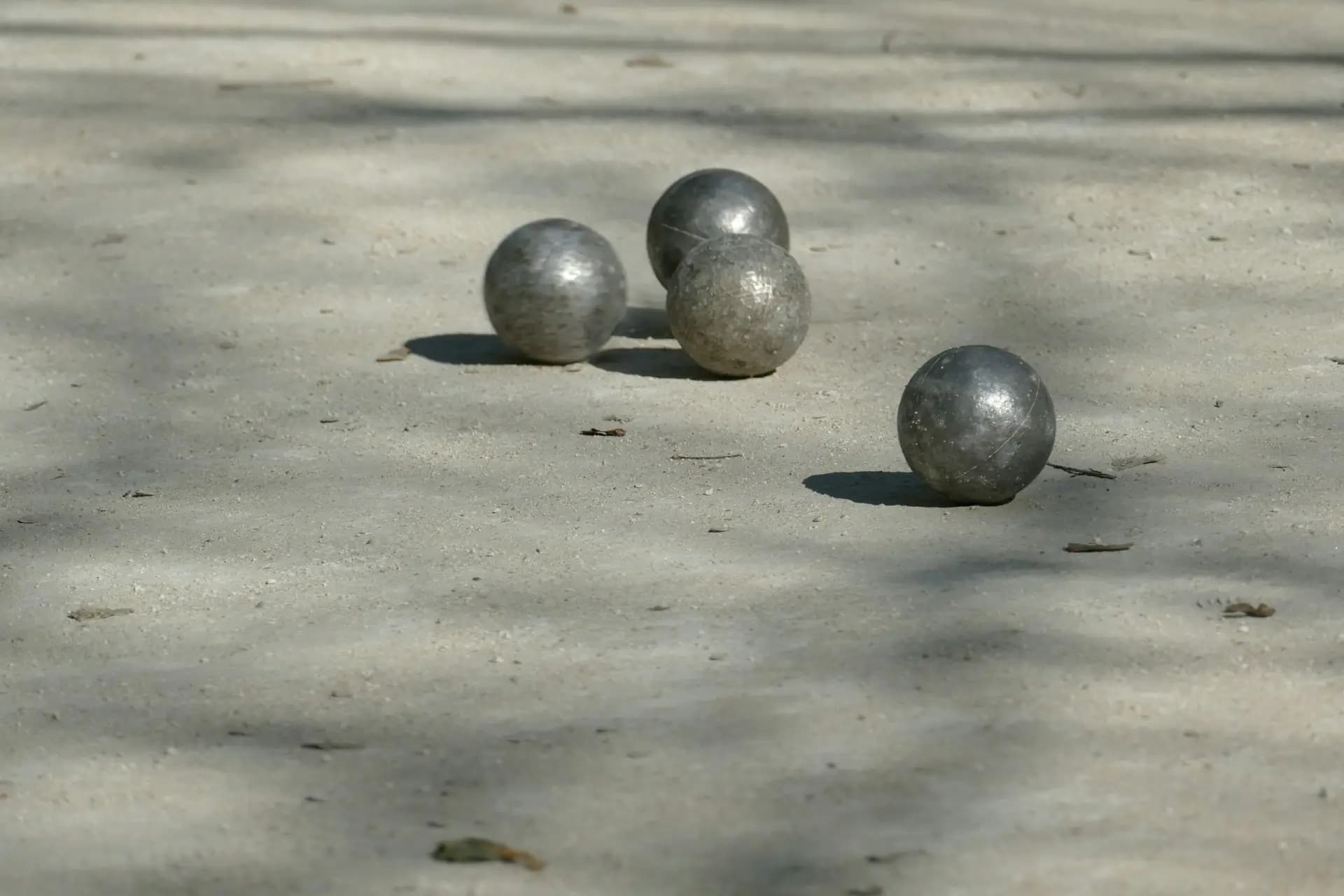
Boules (balls)

Each player has a set of 3 boules; depending on the formation, 2 or 3 boules are used in the game.

Technical specifications

  • Material: metal
  • Diameter: 70.5–80 mm
  • Weight: 650–800 grams

Surface

Smooth or grooved. Any foreign material (e.g., coating, paint, adhesive) is prohibited.

Mandatory markings

Every official boule must display: the manufacturer's mark and the weight (in grams).

Prohibitions

  • Boules filled with lead, mercury, or liquid are prohibited
  • Manipulated or modified boules are prohibited
  • Non-standard size or weight boules cannot be used

Referee consequences

  • Use of irregular boule → immediate disqualification from the match
  • In severe cases → team disqualification may be applied

Jack (Cochonnet) / Small wooden ball

  • Material: wood
  • Diameter: 30 mmregulation allows ± 1 mm tolerance
  • Weight: 10–18 grams

This is a mandatory competition rule. A jack of different size or material cannot be used in official matches.

Circle (throwing circle)

The circle is the circular area from which the player throws the boule.

Size and characteristics (according to regulations)

  • Inner diameter: 35–50 cm
  • Material: can be drawn on the ground, or an official plastic throwing circle can be used

Placement

Marked before throwing the jack, at least 1.5 meters from obstacles and jacks on other courts

Mandatory use: all throws must be made from within the circle

Body position in the circle

Both feet must be entirely inside the circle, not touching the circle line, and cannot leave the circle until the thrown boule has stopped

Important rules

  • The circle must not be moved during the game
  • The circle cannot be erased until the current mène has ended
  • Irregular circle use: first offense warning/yellow card, repeat offense orange card (boules excluded)

How to Play

  1. Starting the Game

    • Choose the starting team by coin toss
    • Draw a circle on the ground (35-50cm diameter)
    • Throw the jack 6-10 meters from the circle
    • The jack must be visible and at least 1 meter from obstacles
  2. Playing Boules

    • Players must throw from inside the circle
    • The starting team throws first
    • Teams alternate throwing until all boules are played
    • You can either "point" (get close to jack) or "shoot" (hit opponent's boules)
  3. Scoring

    • Only one team scores per round
    • Count all boules closer to the jack than the opponent's closest boule
    • Maximum 3-6 points per round depending on formation (if all your boules are closer)
    • First team to reach 13 points or leading according to the rules (time limit plus mène) wins the game
  4. Next Round

    • The winning team starts the next round
    • Draw a new circle in line with the jack's final position, but only moved longitudinally
    • Throw the jack for the new round
    • Continue until one team reaches 13 points or time runs out and the last mène is played

Advanced Rules & Strategies

Playing Techniques

Pointing (Pointer)

Soft throw from the wrist with arm swing back then forward - can be a flat roll, medium-high arc around 2 meters, or a lob 5+ meters high to stop your boule as close as possible to the jack. You can also apply various spins, backspin and/or sidespin to the boule, but these require much practice. After landing, the less the boule moves, the more accurate the result. Technique needs vary depending on terrain. All throws must be underhand only! You can throw crouching, standing up, or upright - the key is that neither foot may leave the ground until the thrown boule lands.

Shooting (Tirer)

There are many techniques for this as well. Flat sliding shot (raspail) - when the terrain allows, throw toward the target boule and let your boule slide once or even multiple times on the ground before impact. Flat, arced stronger relatively low shot - the key is to land on the target boule, hit iron. Arced soft almost drop shot - this is perhaps the most beautiful and overall most effective technique, where the thrown boule's own weight (around 700 grams) ensures the target boule moves from its position upon impact. When the thrown boule and target boule swap positions without movement, we call it an optical carreau. When the thrown boule knocks out the target and stays on the field, it's a carreau. When the thrown boule only touches the top of the target, so there's minimal contact between the two boules but the target doesn't move significantly (almost carreau), we call it a casquette.

Pointing and shootingJackPointingShooting

Pointing rolls the boule close to the jack; shooting knocks the opponent's boule away.

Special Situations

Dead Ball

If the jack goes out of bounds or becomes unplayable, the round is void and replayed by the same team that started the dead round. However, if one team has thrown all their boules but the other team still has boules remaining, the team with remaining boules scores as many points as they have boules left in hand.

Measurement

When distances are unclear, use a measuring tape or string. The closest boule wins the point.

Tournament Regulations

Official Tournament Rules

Time Limits

  • Singles: 1 hour per game
  • Doubles: 1.5 hours per game
  • Triples: 2 hours per game
  • Semi-finals: No time limit

Court Specifications

  • Length: 12-15 meters minimum
  • Width: 3-4 meters minimum
  • Surface: Hard-packed earth or gravel
  • Boundaries clearly marked
Petanque terrain dimensionsThrowing circleØ 35–50 cmJack lands 6–10 m awayJack6 m10 mLane length: 15 m4 mBoundary: a boule fully across the line is dead

Regulation lane: 15 × 4 m. The jack must land 6–10 m from the circle, at least 1 m from any obstacle or boundary.

The rules in depth

Out of bounds and dead boules

A boule is dead the moment it fully crosses the boundary of the lane (the dead-boule line) — it is removed from play even if it rolls back in. On open ground without marked lanes, agree the boundaries before you start.

The jack is dead when it is knocked out of the lane, ends up hidden from the circle, or finishes more than 20 m from or closer than 3 m to the circle after being hit.

Measuring and disputes

Whenever it is unclear which boule is closer, the team that played last measures — with a tape or folding measure, never with your feet. If a player moves a boule or the jack while measuring, the point goes against them.

If the teams still disagree, the referee decides, and the referee's measurement is final. In tournaments run on PlusPetanque, teams call the referee to their terrain straight from the live match screen.

Penalties and cards

Official play uses a card system: a yellow card is a warning — for slow play, foot faults in the circle, or smoothing the terrain. A further offence can void the boule played (orange card), and serious or repeated offences exclude the player or team (red card).

Referees on PlusPetanque record warnings and cards digitally during the match, so the official escalation is followed automatically.

Competition vs leisure boules

Competition boules must be approved: steel, 70.5–80 mm across, 650–800 g, with the maker's mark and weight stamped in the metal. Cheap leisure sets fall outside these tolerances and are not allowed in sanctioned events.

Tampering — filling, rebalancing ('stuffed' boules) or re-hardening — is cheating and leads to disqualification and possible suspension. The jack is wood or approved resin, 30 mm in diameter.

Frequently asked questions

How many points do you need to win a petanque game?
The first team to reach 13 points wins — there is no time limit and no draw; you play as many ends as it takes.
How many players are in a petanque team?
Teams have 1, 2 or 3 players (singles, doubles, triples). Singles and doubles use three boules per player; triples use two.
How long does a petanque game last?
A typical game to 13 points lasts roughly 60–90 minutes, depending on format and level. Tournament play often adds a time limit per match.
How does scoring work in petanque?
Only one team scores in each end: it gets one point for every boule closer to the jack than the opponent's best boule.
How do you start a petanque game?
A coin toss decides who begins. The starting team draws the circle, throws the jack 6–10 m, and plays the first boule.
How far do you throw the jack in petanque?
The jack must be thrown 6–10 metres from the throwing circle, at least 1 metre from any obstacle or out-of-bounds line.
How big is a petanque court?
A regulation lane is 15 m long and 4 m wide; national events may allow 12 × 3 m. Casual games work on any reasonably firm ground.
What happens if the jack is knocked out of play?
If the jack is knocked out of play while both teams still have boules, the end is void and replayed. If only one team has boules left, it scores one point for each boule it still holds.
Can you play petanque one against one?
Yes — tête-à-tête (one against one) is an official format with three boules per player. Doubles also play three each; in triples each player has two.
What do the penalty cards in petanque mean?
A yellow card is a warning — for slow play, foot faults or altering the terrain. An orange card disqualifies the boule, and a red card excludes the player or team; for serious offences such as unsporting behaviour, threats or physical violence the red card can be shown immediately.

Put the rules into practice

Find an upcoming petanque tournament and register your team online — free.

Browse tournaments