
Petanque glossary
The words you hear on the terrain, explained in plain language. Most of them are French and are used unchanged everywhere the game is played.
Barrage
- A play-off match between teams that finished a poule with one win and one loss. The winner qualifies for the knockout stage; the loser goes home. Also the name of the classic French tournament format built on this round.
Boule
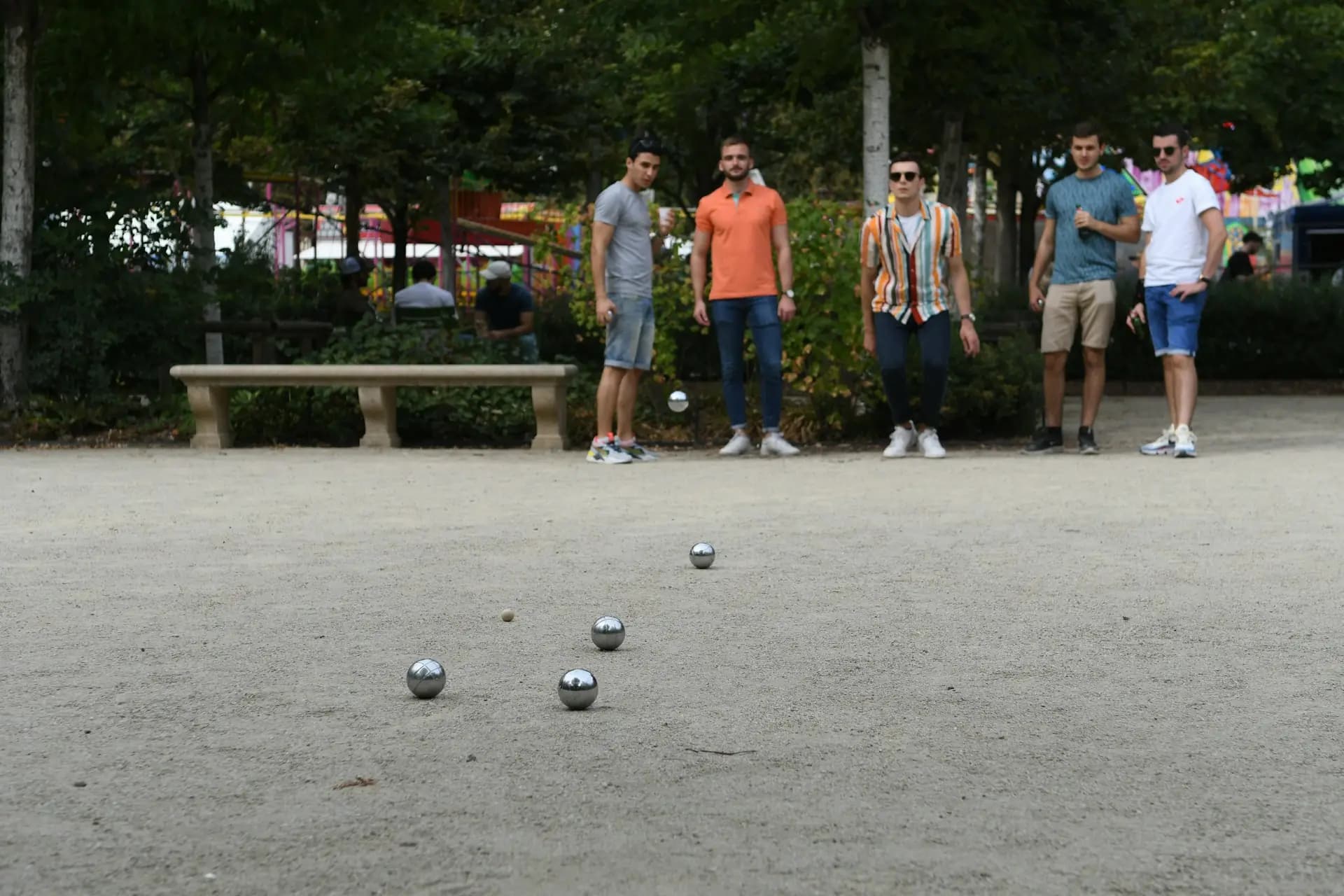
- The hollow steel ball each player throws. In competition it must be metal, 70.5 to 80 mm across and 650 to 800 g. A player has three boules in singles and doubles, two in triples.
Boulodrome
- A dedicated petanque ground, usually a set of marked lanes on gravel or packed earth, often covered so the game can be played all year.
Buchholz
- A tiebreaker used in Swiss-system tournaments: the sum of the wins of all the opponents a team has faced. A higher Buchholz score means the team played tougher opposition.
Carreau
- The perfect shot: the thrown boule hits an opponent's boule and takes its exact place, staying where the target was. The most admired throw in the game.
Cochonnet
- The small wooden target ball, 30 mm across, also called the jack or the but. Every end is scored by how close the boules finish to it.
Donnée
- The landing spot a pointer aims for so that the boule rolls to rest near the cochonnet. Reading the terrain to pick the right donnée is the pointer's craft.
Doublette
- The two-a-side format. Each player has three boules, so each team throws six per end.
Fanny
- Losing a game 13 to 0. Tradition says the losers must kiss the backside of a picture or statue of Fanny, which most clubs keep on the wall for the occasion.
Mêlée
- A tournament where teams are drawn at random rather than entered pre-formed. In a super mêlée the draw is redone every round.
Mène
- One end of play: the cochonnet is thrown, all boules are played, and points are counted. A game is a series of mènes until one side reaches 13.
Milieu
- The middle player in a triplette, who both points and shoots depending on the situation. The pointeur points, the tireur shoots, the milieu does either.
Pointing
- Throwing a boule so that it rolls or drops to rest as close to the cochonnet as possible. Called pointer in French; the player who specialises in it is the pointeur.
Poule
- A group of four teams that play each other in a qualifying stage; the group results decide who advances. The basis of the barrage format and of group-plus-knockout tournaments.
Shooting
- Throwing a boule through the air to hit and knock away an opponent's boule or the cochonnet. Called tirer in French; the specialist is the tireur.
Terrain
- The playing area. In competition each match is played on a marked lane, typically 15 by 4 metres, with boundary lines beyond which a boule is dead.
Tête-à-tête
- The singles format, one player against one, with three boules each.
Throwing circle
- The circle a player throws from, 35 to 50 cm across, drawn on the ground or a plastic ring. Both feet stay inside it and on the ground until the boule has landed, which is where the name petanque comes from: pieds tanqués, feet planted.
Triplette
- The three-a-side format, with two boules per player and six per team. The classic championship format.